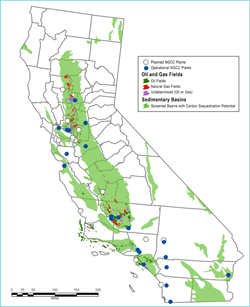
Assessment of CCS for Gas-Fired Power PlantsModern, utility-scale natural gas combined cycle (NGCC) power plants have relatively modest CO2 emissions per megawatt-hour (compared with coal-fired plants), but their predominance in West Coast electricity markets—particularly California—places them among the WESTCARB region’s largest CO2 point sources. To better understand the impacts of CCS on NGCC units, WESTCARB conducted an integrated study of CO2 capture, compression, transportation, and utilization/storage technologies for both retrofit and new-build applications. The study reviewed CO2 capture technologies suitable for NGCC application, mapped the proximity of California NGCC plants to locations with CO2-enhanced hydrocarbon recovery or saline storage potential, and modeled the cost and performance impacts of applying CCS at retrofit and new-build NGCC plant sites. Participation in the study by California electric utilities helped assure real-world relevance and facilitate engagement with key stakeholders. A WESTCARB Preliminary Assessment tabulated California NGCC plant design and operational characteristics and examined plot plans and/or satellite photos to ascertain space availability for potential addition of CO2 capture and compression equipment. Lawrence Livermore National Laboratory developed a preliminary geology report on the suitability of CO2 utilization and storage options beneath or near 42 California NGCC facilities. The final engineering-economic report was published by the California Energy Commission.
|
Click image to enlarge
|