

A stratigraphic well drilled in December 2011 provided WESTCARB with rock core and fluid samples to characterize the CO2 storage potential of regionally extensive geologic formations in the southwestern part of the Sacramento Basin of California.
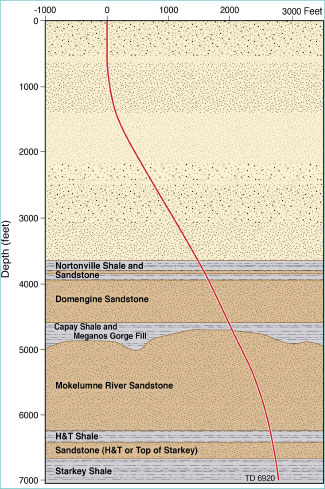 |
| Stratigraphic column of the Citizen Green site showing the well trajectory through a sequence of sandstones and shales. |
The Citizen Green well, a California Energy Commission project, was drilled directionally to a vertical depth of 6,900 feet, reusing the pad and surface casing of an existing depleted natural gas well on King Island near Stockton. The King Island gas field is part of northern California’s natural gas producing region and is in proximity to major industrial and power plant CO2 sources.
Rock and fluid samples and logging data collected from the well served to assess the injectivity of regional sandstone formations to store CO2 and the integrity of the overlying shale units to provide seals against leakage.
Whole core recovered during drilling included 19 feet of the transition between the Nortonville Shale and Domengine Sandstone and 57.5 feet of the upper Mokelumne River Sandstone. In addition, 43 sidewall cores were recovered from the Domengine, Mokelumne, and upper Starkey* (or lower H&T) sandstones, and the Nortonville, Capay, and H&T shales. Wireline logs were run over a vertical depth range of 3,250 to 6,880 feet to provide data on the porosity, permeability, mineralogy, and geomechanical properties of the formations.
The core samples were analyzed and used in experiments by WESTCARB researchers at Lawrence Berkeley National Laboratory.
WESTCARB’s findings from the Citizen Green well samples and logging data show excellent potential for CO2 storage in several sandstone formations, as well as good sealing properties in the shales. This information can help the region’s CO2 emitters better assess geologic storage options for meeting their greenhouse gas reduction targets, as well as helping natural gas producers determine how CO2 injection may extend the useful life of depleting natural gas fields.
*A preliminary assessment of the Mokelumne River and Starkey formations was conducted by the California Geological Survey.