| Northern California CO2 Reduction Project
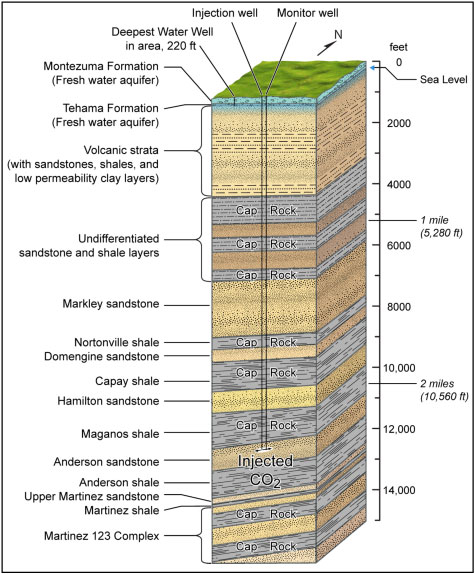
The Northern California CO2 Reduction Project examined deep saline formations prevalent throughout California's Central Valley as candidate locations for CO2 storage projects. A site in the Montezuma Hills of Solano County was selected for detailed geologic modeling and permit development for a small-scale CO2 injection to ascertain storage capabilities.
The project was a collaborative undertaking between WESTCARB and C6 Resources, an affiliate of Shell Oil Company. The project team developed a 3D model based on well log and seismic survey data from natural gas exploration, production, and storage operations in the area. The team used the model to simulate a research-size injection of 6000 tons of CO2. Results suggested that the site has excellent CO2 storage potential. Permit applications for well construction and CO2 injection were developed, and several public meetings were held in Rio Vista, California, in 2010. U.S. EPA Region 9 issued a draft Underground Injection Control permit, however, the project concluded when C6 Resources decided not to proceed.
|
A stratigraphic column of the study site in the Montezuma Hills, showing the numerous caprock layers that help keep CO2 (simulated injection) in the target formation. |
|
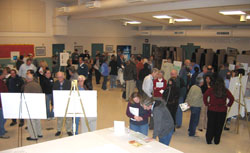
Attendees at the open house in Rio Vista, California, discuss the Northern California CO2 Reduction Project with project team members. (January 28, 2010)
|